

Biden Just Signed an Executive Order Protecting LGBTQ+ Youth – Read it Here

On June 15, 2022, President Biden signed the Executive Order “Advancing Equality for Lesbian, Gay, Bisexual, Transgender, Queer, and Intersex Individuals.” This order is intended to counteract the wave of discriminatory, anti-LGBTQ+ legislation that has been sweeping across conservative parts of our country in the past year.

The provisions in the act are summarized in a Fact Sheet released by the White House (read it here). They include:

Addressing discriminatory legislative attacks against LGBTQI+ children and families, directing key agencies to protect families and children; 

Preventing so-called “conversion therapy” with a historic initiative to protect children from the harmful practice;

Safeguarding health care, and programs designed to prevent youth suicide;

Supporting LGBTQI+ children and families by launching a new initiative to protect foster youth, prevent homelessness, and improve access to federal programs; and

Taking new, additional steps to advance LGBTQI+ equality. 

While signing the act as part of Pride Month, President Biden made it very clear to all LGBTQI+ people: “We have your back.

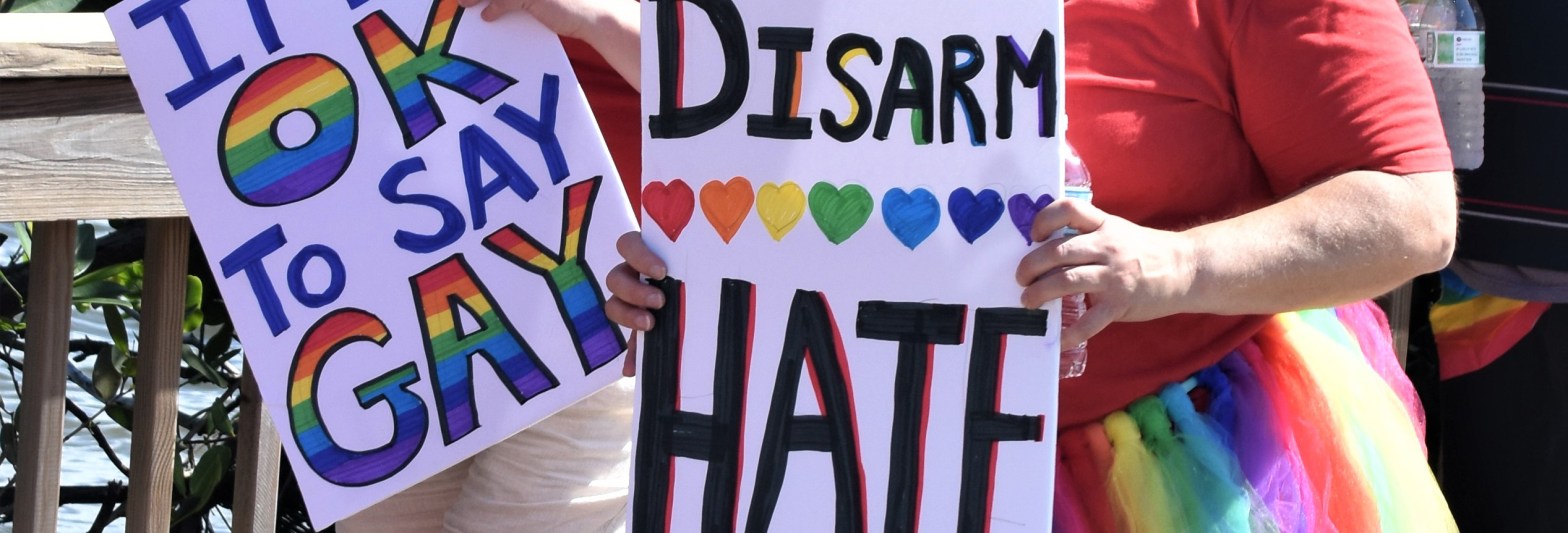
Having spoken with many students impacted by Florida’s new “Don’t Say Gay” law, as well as Gay-Straight Alliance advisors, school social workers, and mental health professionals, I can attest that the need for outspoken protection is vital. In addition to the protections afforded by the Executive Order, its very existance sends a message to all LGBTQI+ youth out there: Our President, our Federal government, is on your side.
Great Article on Gender Identity

This article is from Men’s Health. Link below …

“There’s a chance you landed here because you may not totally be clear on all the terms and phrases to express gender identity. “It’s understandable that some folks may feel confused or even uncomfortable with all the variations of gender, gender identities, and gender roles,” says Tracy Marsh, PhD, faculty member for Walden University’s PhD in Clinical Psychology program, and a licensed psychologist in California who specializes in LGBTQIA issues. Or, you could be exploring your own gender identity and looking for the right words to express yourself and help others understand.

Thankfully, it’s 2021, and many of the terms surrounding gender are becoming more widely recognized in our society. “These concepts and terms will continue to evolve. The best way to stay informed is to reach out and have a respectful dialogue with someone who has more knowledge of these terms and topics. Ask others how they identify and how they prefer to be addressed,” Marsh says.

Women’s Health spoke to experts on those questions you may want to ask, but don’t know exactly where to start: What exactly does gender identity mean? What is biological sex vs. gender? And how do gender identity and sexuality relate? First, Jackie Golob, MS, who works at a private practice at the Centre for Sexual Wellness in Minnesota, provides an overview on some commonly confused ideas surrounding gender identity.

  • Genitalia does not equal gender. “The sex characteristics a person is born with do not signify a person’s gender identity. When people have ‘gender reveal parties,’ it really should be called a ‘genital reveal party,’” she offers. The concept of gender really is a social construct, adds Golob.
  • Forget about the two-gender binary. “Gender is a term that relates to how we feel about ourselves, the way we choose to express our gender through makeup, dresses, high heels, athletic shorts, sneakers, and more,” she explains. Our society has convinced us that there are just two options for gender identity, “male” and “female,” based on biological sex. But in reality, there’s more fluidity.
  • Gender identity is on a continuum. It’s not just the male/female gender binary—there’s a spectrum of gender identity. “[Most people] lie in between [the binary], with personality traits that relate to gender identity, expression, and biological sex. Gender identity can change over time, and it is not fixed,” says Golob. Just because you identify one way at one point in time, does not mean you will always choose that identity, or that your identity won’t shift and evolve.
  • Sexuality and gender identity are not the same thing. “Gender identity is how you feel about yourself and the ways you express your gender and biological sex,” says Golob. Meanwhile, sexuality refers to who you are emotionally, physically, romantically, or sexually attracted to, she says. In summary, “gender is how you feel about yourself, while sexuality is how you feel about others,” says Golob.

Now that you have the basics, let’s do a deep dive into gender identity terms and what they each mean.”

Read the rest here.

Happenings … In the News

In the news of late:

The University of Central Florida Police conducted training for the Orange County Sheriff’s Office and the Orlando Police Department on how to be respectful of members of the LGBTQ+ community.

Lieutenant Brandon Ragan with the OCSO said this: “It just gives them that sense of, you know, peace and acknowledgement, you know, that ‘They really do care how I identify and they do.’ That starts that respecting back and forth when you’re trying to build a rapport.”

Officers learned about the importance of respecting people’s pronoun preferences as well as other important aspects of interaction.

Read about this training, and access the program’s information, here.

In less feel-good news, unfortunately many states continue to ramp up their attacks on the transgender community. Florida governor DeSantis is working to ban care for transgender youth, following in the footsteps of other states such as Texas (whose law currently stands) and Alabama (whose law has been temporarily blocked in court).

Additionally, in a particulary gross and upsetting turn of events, Ohio legislators have approved a measure allowing “genital inspection” of athletes “suspected” of being transgender.

This Salon article discusses these and other recent acts of anti-trans bigotry.

While it’s important to celebrate the victories it’s also important to stay vigilant and continue to stand up for and protect our trans community every day.

Sign up to receive new posts in your inbox

Candidates for Brevard County School Board

Recently at a candidate forum held by Families for Safe Schools, in Brevard, I had the opportunity to speak with three school board candidates about how they would protect LGBTQ+ students in Brevard schools. Hear Erin Dunne, Kim Hough, and Misty Belford discuss that and other issues pertaining to Brevard’s schools and students.

Brevard 2022 School Board Candidates

Sign up to receive new posts in your inbox

Democratic Candidates for Congressional District 8

Recently Families for Safe Schools held a forum for candidates in Brevard County. I was able to briefly interview two Democratic candidates for Congressional District 8, a seat currently held by Bill Posey.

I spoke with Joanne Terry and Danelle Dodge about what they would offer to the district, as well as how they would work at the federal level to protect LGBTQ+ kids.

Here’s what they had to say.

Democratic Candidates for Congressional District 8

Sign up to receive new posts in your inbox

School Board Candidates for Brevard County

Recently at a candidate forum held by Families for Safe Schools, in Brevard, I had the opportunity to speak with three school board candidates about how they would protect LGBTQ+ students in Brevard schools. Hear Erin Dunne, Kim Hough, and Misty Belford discuss that and other issues pertaining to Brevard’s schools and students.

Here’s Misty Belford:

Misty Belford Interview

Here’s my interview with Kim Hough:

Kim Hough Interview

And here’s Erin Dunne:

Erin Dunne Interview

We are past the day and age where we can pretend that any election doesn’t matter. Every election at every level matters. Vote like our kids’ lives depend upon it. On so many levels, in so many ways, they do.

Democratic Candidates for Congressional District 8

Recently Families for Safe Schools held a forum for candidates in Brevard County. I was able to briefly interview two Democratic candidates for Congressional District 8, a seat currently held by Bill Posey.

I spoke with Joanne Terry and Danelle Dodge about what they would offer to the district, as well as how they would work at the federal level to protect LGBTQ+ kids.

Here’s what they had to say.

Here is Danelle Dodge’s interview:

Danelle Dodge Interview

And here’s Joanne Terry:

Joanne Terry Interview

Remember, our vote is our voice. Let you voice be heard. Evaluate the candidates, and work for the representation that represents what you want your city, county, state, and federal government to be.

LGBTQ+ in the News

Here’s some of what I found in the news in the past week concerning LGBTQ youth.

First, a feel-good story. I came across an article from April 15 of this year about a photographer who “highlights trans youth to put a face behind the headlines.” The photographer, Jess Freidin, takes portrait photos of trans youth surrounded by their supportive family members. Freidin will be traveling the country meeting and photographing these youth and their families. “The goals is to really put a humanizing face to the terrible, dangerous, violent effects of anti-trans laws that we’re seeing pop up.” Read more about Freidin’s project here.

Second, there is a wonderful new pamphlet out, free of charge, with the goal of helping parents learn how to talk with their kids about gender identification. The short (1-page) leaflet is easy to read and to the point, discussing gender identity vs. sexuality, sexual preference, or biological sex. It shares why this topic is an important one to discuss, and how to approach the conversations. The authors are Dr. Marcia Matthews, who has a PhD in Human Sexuality and has practiced as a psychotherapist; Robin Matthews, who holds a certification in elementary education and works for a non-profit serving Jewish LGBTQ+ families; and Steve Fradkin, who has a BS in Business Administration. Read and download the pamphlet here.

Third, did you know that it is unlawful to remove books from school libraries just because the books address LGBTQ+ themes or have LGBTQ+ characters/information? The Supreme Court has found that removing books for that reason amounts to “viewpoint discrimination” – and violates the First Amendment. Just as students have the right to form Gay Straight Alliance clubs – and to call them Gay Straight Alliances – students have the right to have LGBTQ+ representation in their school libraries. If you need more information on this topic, please read the comprehensive article by Lambda Legal, “Preventing Censorship of LGBT Information in Public School Libraries.”